
Bambu Lab X2D vs X1C: Is the Dual-Nozzle Upgrade Worth It?
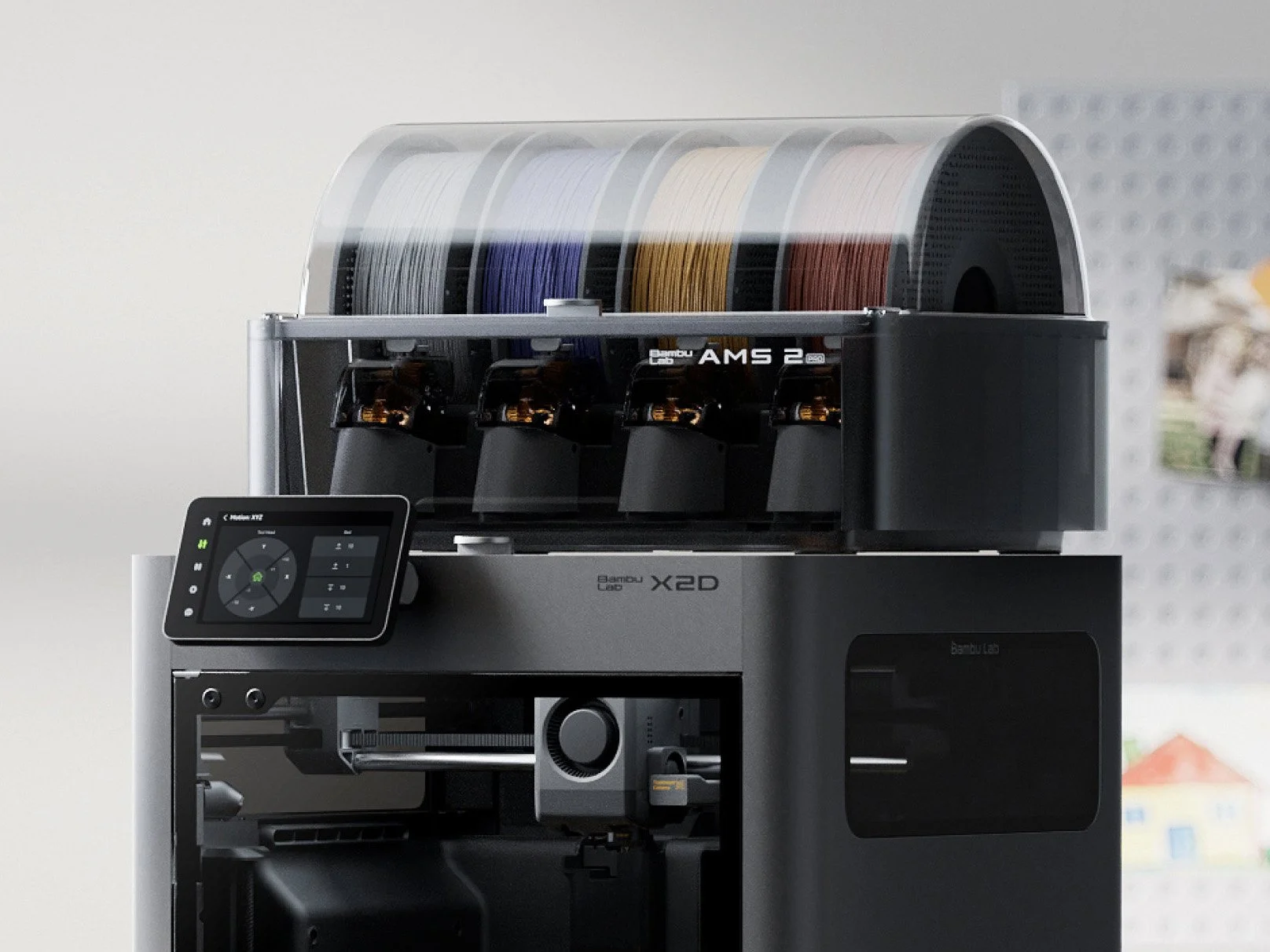
With the launch of the Bambu Lab X2D, Bambu Lab has again set the bar on accessibility to powerful 3D printing, and does so beyond simple color swapping to dual extrusion in a smart way. While the X1C revolutionized speed, simplicity of printing and how we use multiple colors and materials with the AMS.
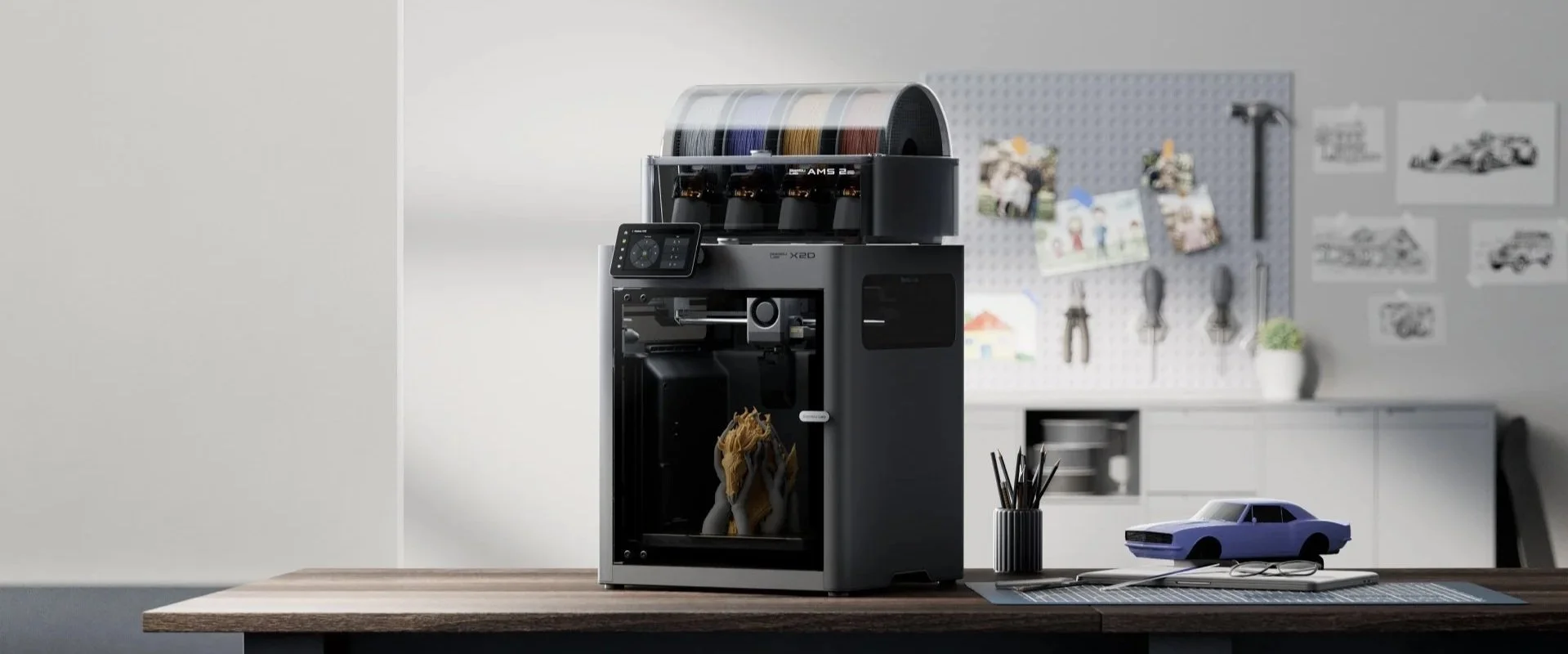
The X2D takes things a step further by introducing an extremely compact dual extrusion system with part direct and part Bowden style extrusion in one compact toolhead. Real engineering grade 3D printing with efficient multi-material approach at an incredible price of just $899 (or $649 without the AMS combo) - Check it out here.
Bambu Lab X2D Key Specs And Features:
Build volume (Single nozzle): 256 × 256 × 260mm
Build volume (dual nozzle intersection): 235 × 256 × 256mm
Extruder type(s): Dual with Direct extrusion in toolhead, and Bowden on the back for 2nd (auxiliary) nozzle.
Max Nozzle Temp: 300°C
Max Bed Temperature: 120°C
Max Chamber Temperature: 65°C
Tool-free nozzle swap: Yes (quick release, compatible across X2, H2 and P2 series)
Vision Encoder support: Accuracy down to 50 microns
Chamber ventilation: intelligent thermal system ( automatic Cold / Hot mode )
Price (excluding tax): $649 / €629 for X2D standalone and $899 / €849 for the X2D Combo with AMS. All immediately available here.
D for Dual Extrusion
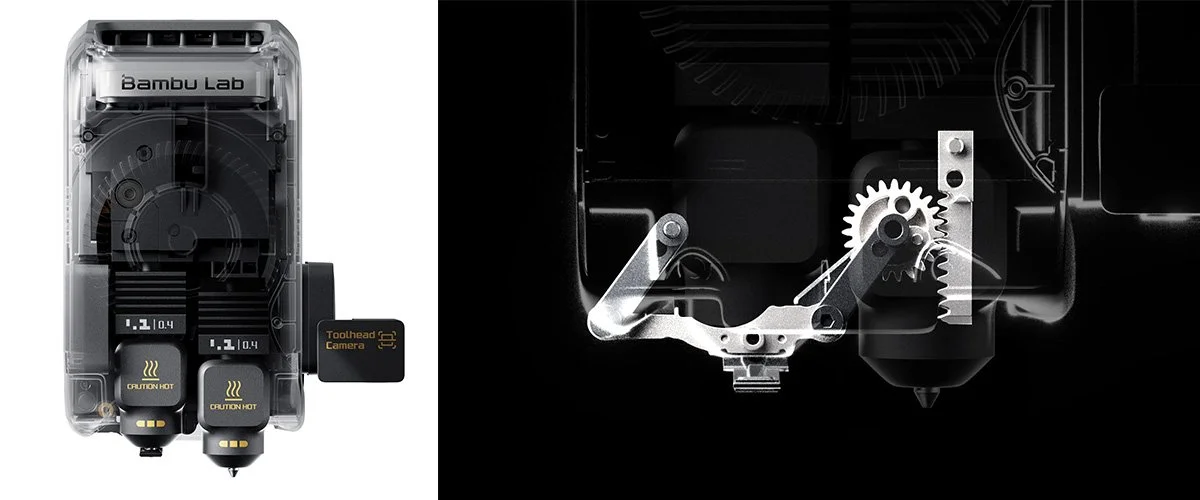
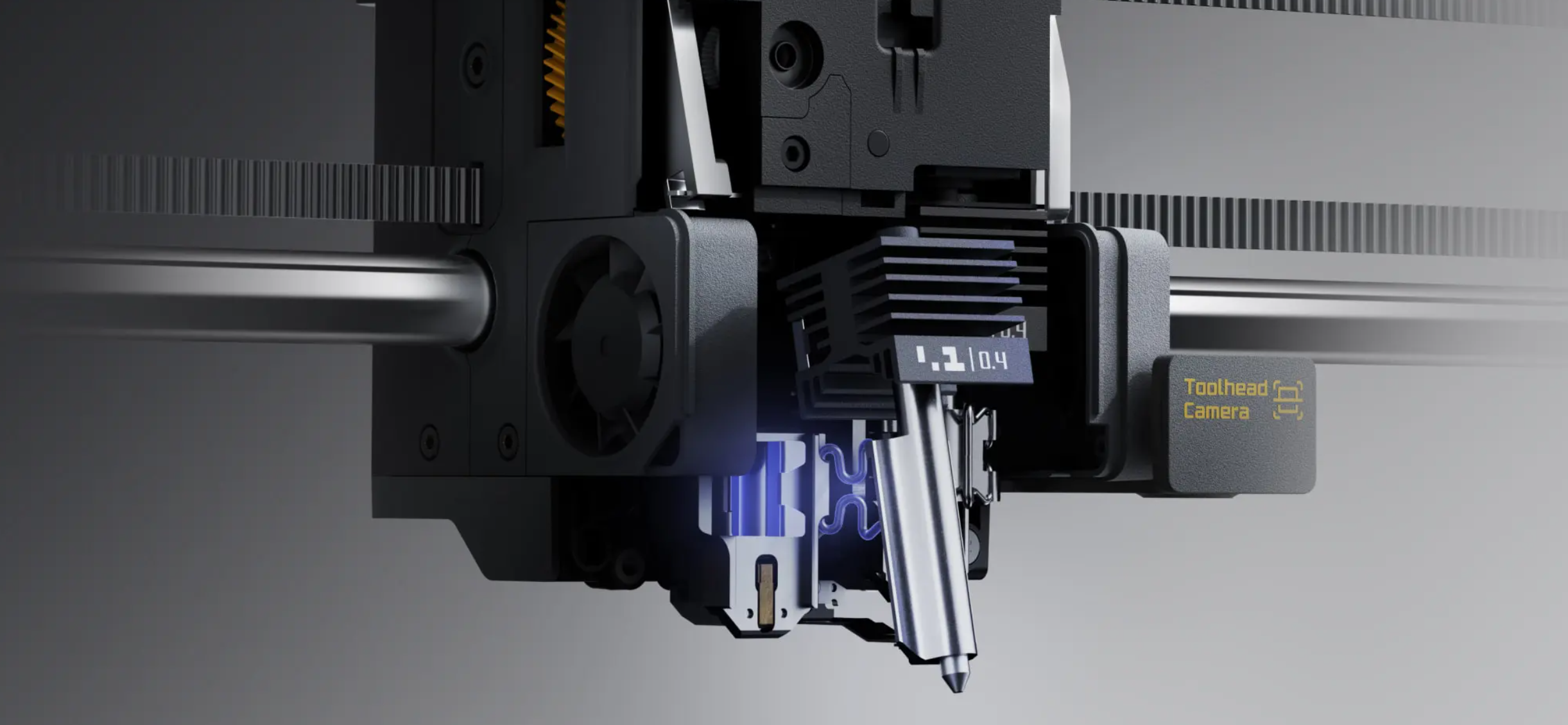
The most significant change in the X2D is the move to a dual-nozzle setup. Unlike the complex, heavy toolhead found on the H2D, which uses two gears on a single motor, the X2D utilizes a smart split architecture. The primary nozzle uses a classic direct-drive setup like we're used to, with a motor pushing the filament directly into the nozzle. The secondary (auxiliary) nozzle operates via a Bowden configuration from the rear of the machine to save weight and size, enabling the bigger build volume since the print head is not significantly bigger.
The nozzle switching itself is handled by a purely mechanical system with no additional motor. The nozzle-change lever taps a trigger arm, driving an internal gear train to raise one nozzle and lower the other. No extra weight, no extra electronics. Bambu Lab claims over one million switching cycles in durability testing.
In practice, this means you can use one nozzle for your main printing regularly with one or more AMS modules, and the other specifically for soluble or easy-to-remove support materials like PVA or BVOH. This drastically reduces post-processing time.
It also should save a lot on AMS-filament switching times, as the support can be ready to go in the 2nd nozzle, speeding up multi-material/color printing in some scenarios by a lot.
By keeping the secondary motor at the rear, Bambu Lab has kept the toolhead light enough to maintain high acceleration without the weight penalty seen in larger machines.
Both nozzles use the same tool-free, quick-release design introduced on the A1 and refined for the H2 and P2 series, and nozzles are compatible across the entire X2, H2 and P2 lineup.
Not a tool-changer
While many might have expected a tool-changer system like the H2C at the A/P/X-series build volume, this approach caters very well to the industrial and engineering users who are looking for ways to scale and simplify production of “useful” parts.
Update: It’s now verified and clear that you can use AMS-systems from each nozzle, as shown in Thomas Sanladerer’s early review. This is great news for advanced multi-material setups. One great example is to have one AMS 2 Pro just loaded with different types of support-materials if you’re running complex parts in production. Or you know, just buying extra AMS so you can have “all” your filament ready without touching the machine.
Thermal Management and Materials
The X2D finally gives us active chamber heating up to 65°C, a feature previously reserved for H-series or enterprise models like X1E. This is a critical upgrade for anyone moving beyond PLA and PETG. Active heating helps prevent warping in high-temperature materials such as ABS, ASA, and Nylon by maintaining a stable thermal environment throughout the print.
The hotend can reach 300°C (lower than the rumored 350°C unfortunately), making it compatible with most engineering filaments. When paired with the "Heat Mode" for the chamber, the X2D is significantly more capable of printing structural parts than the P2S or the original X1C.
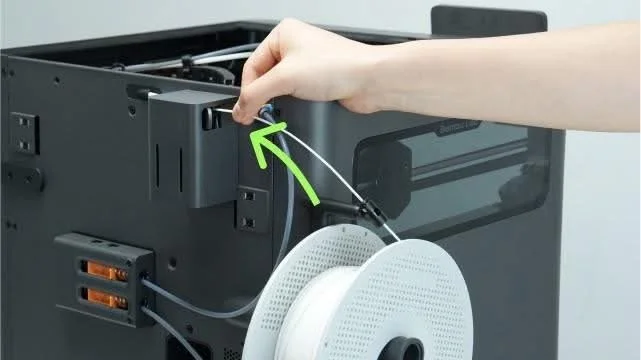
Rear extruder and “auxiliary nozzle” filament. I suspect this can be used with AMS as well, perfect for drying PVA for example.
Second Generation Extrusion and Monitoring
Bambu Lab has integrated many of its recent "2nd gen" technology in motion control into this new model. The printer features a PMSM servo motor for the primary extruder, sampling torque and position up to 20,000 times per second. This allows the system to detect filament jams or deviations before they result in a failed print. Note that the PMSM servo motor is equipped on the main extruder only, and Flow Dynamics Calibration also applies to the main nozzle only.
This level of monitoring is inherited from the H-series with a total of 31 sensors to monitor everything from filament path integrity to thermal stability. This helps ensure the "set and forget" reliability that we've seen for simpler materials and that defines the Bambu Lab experience, but now for even more engineering-grade materials.
The X2D features both a 1080p Liveview camera and a toolhead camera. Before printing, these cameras scan the build plate for debris or leftover prints and verify what build plate type is loaded. During printing, they watch for spaghetti, nozzle clumping, and poop-chute jams in real time and pausing before it wastes hours of time and filament. The X2D does not include a BirdsEye Camera or a Nozzle Camera (those remain H-series features).
With support for Vision Encoder (sold separately), the X2D can achieve motion accuracy down to 50 microns, making sure your measurements hold up from CAD to print.
Who The X2D Is For
The X2D is designed for a specific type of user: the engineer or professional hobbyist who needs reliable printing in advanced materials.
Engineering Prototypes: If you are printing parts in ASA, ABS, or PA (Nylon), the heated chamber and high nozzle temperatures make this a primary choice.
Multi-Material Enthusiasts: Users who need to print functional parts with easy-to-remove supports will find the dual-nozzle system far more efficient than the single-nozzle swapping used in the P2S or X1C.
Small Batch Production: The ability to use a dedicated support material allows for cleaner surface finishes on complex geometries, which is essential for parts that require minimal post-processing.
Who Should Look Elsewhere
The X2D is not a universal upgrade. There are clear instances where other machines in the lineup serve your needs better.
Large Format Needs: If you need to print objects larger than 250mm, the X2D will be too restrictive. You should look toward the H2Sor H2D, which offer significantly larger build volumes.
Budget-Conscious Hobbyists: For users primarily printing PLA, PETG, or TPU for decorative purposes, the X2D is an unnecessary expense. The A-series remains a "sweet spot" for value and performance in the Bambu Lab ecosystem.
Multi-modal Manufacturing: If you require 40W laser engraving, cutting or massive extrusion forces and 350°C nozzle temperature, the H-series machines are the correct choice.
Comparison: X2D vs P2S vs H2D
Swipe left to view full table →
| Feature | Bambu Lab X2D | Bambu Lab P2S | Bambu Lab H2D |
|---|---|---|---|
| Nozzle Setup | Dual (Direct + Bowden) | Single (Direct) | Dual (Direct + Direct) |
| Build Volume | 256 × 256 × 260 mm | 256 × 256 × 256 mm | 350 × 320 × 325 mm |
| Max Print Speed | 1,000 mm/s / 200 mm/s (aux) | 600 mm/s | 600 mm/s |
| Max Nozzle Temp | 300°C | 300°C | 350°C |
| Chamber Heating | Active (up to 65°C) | Passive/Enclosed | Active (up to 65°C) |
| Nozzle Swap | Tool-free quick-release | Tool-free quick-release | Tool-free quick-release |
| Cameras | Liveview + Toolhead | Liveview | Liveview + Toolhead + Nozzle + BirdsEye |
| Primary Use Case | Engineering / Multi-material | Mid-range Hobbyist | Industrial All-in-one |
| Price (from) | $649 | $549 | $1,999 |
The X2D sits in a unique position as It is much more capable than the P2S because of its dual-nozzle capability and active chamber heating, but it lacks the massive build volume and laser/cutting tools of the H2D.
While our earlier breakdown of the leaked specs suggested a focus on simple upgrades, the reality is that the X2D introduces a fundamental change in the lineup as it’s priced at just $899 for the combo.
The B2S WASthe budget king for enclosed Bambu Lab 3D Printers, but now I can’t justify getting the P2S to save $100. It could be a deal-breaker for some, but even if you’re just using one extruder/nozzle, the X2D adds more sensors, heated chamber and capability that is well worth the $100 if you actually need an enclosure and arn’’t happy with what Bambu Lab A1 can offer at $299/$399.
3D Print Tech Design Verdict
The Bambu Lab X2D is a highly capable 3D Printer that isn't just a "faster X1C"; it is a proper shift to Bambu Lab latest gen technology for high-end multi-material 3D printing.
By using a split direct/Bowden architecture, Bambu Lab has managed to deliver dual extrusion at a price point ($649–$899) that remains accessible to the prosumer market, in the same form factor we've grown used to.
I don't think anyone should consider the P2S when you can have the X2D for just $100 more. And certainly if you're doing high-end 3D printing and were looking at getting the H2D but felt like you're overpaying for a volume you don't need, the X2D is perfect.
Not to mention the support for much easier support-handling without the long AMS-unloading process.
Bambu Lab X2D Specifications And Features
Build volume Main Nozzle: 256 × 256 × 260 mm
Build volume Auxiliary Nozzle: 235 × 256 × 256 mm
Build volume Dual Nozzle: 235 × 256 × 256 mm
Motion System: CoreXY
Enclosure: Yes - Intelligent thermal system (active vents)
Extruder Gear Assembly: Hardened Steel
Nozzle Type: Hardened Steel
Max Nozzle Temp: 300°C
Max Bed Temperature: 120°C
Max Chamber Temperature: 65°C
Flap Switch Airflow & Filtration System: Yes
Air Filter: G3, H12, Coconut Shell Carbon Filter, VOC & Particulate Matter Filtration
AMS Compatibility: AMS 2 Pro, AMS, AMS HT
Max Materials Supported in one print: 25
Filament Run Out Sensor: Yes
Filament Grinding Detection: Yes
Filament Tangle Sensor: Yes
Nozzle Camera: No
Liveview Camera: 1080p high rate
Toolhead Camera: Yes (AI print monitoring, build plate verification)
AI Detection: Yes
Display: 5” Color Touchscreen
Vision Encoder support: Accuracy down to 50 microns
Ideal Material Support (main nozzle): PLA, PETG, TPU, PVA, ABS, ASA, PA, PC, PET, Carbon/Glass Fiber Reinforced Polymer
