
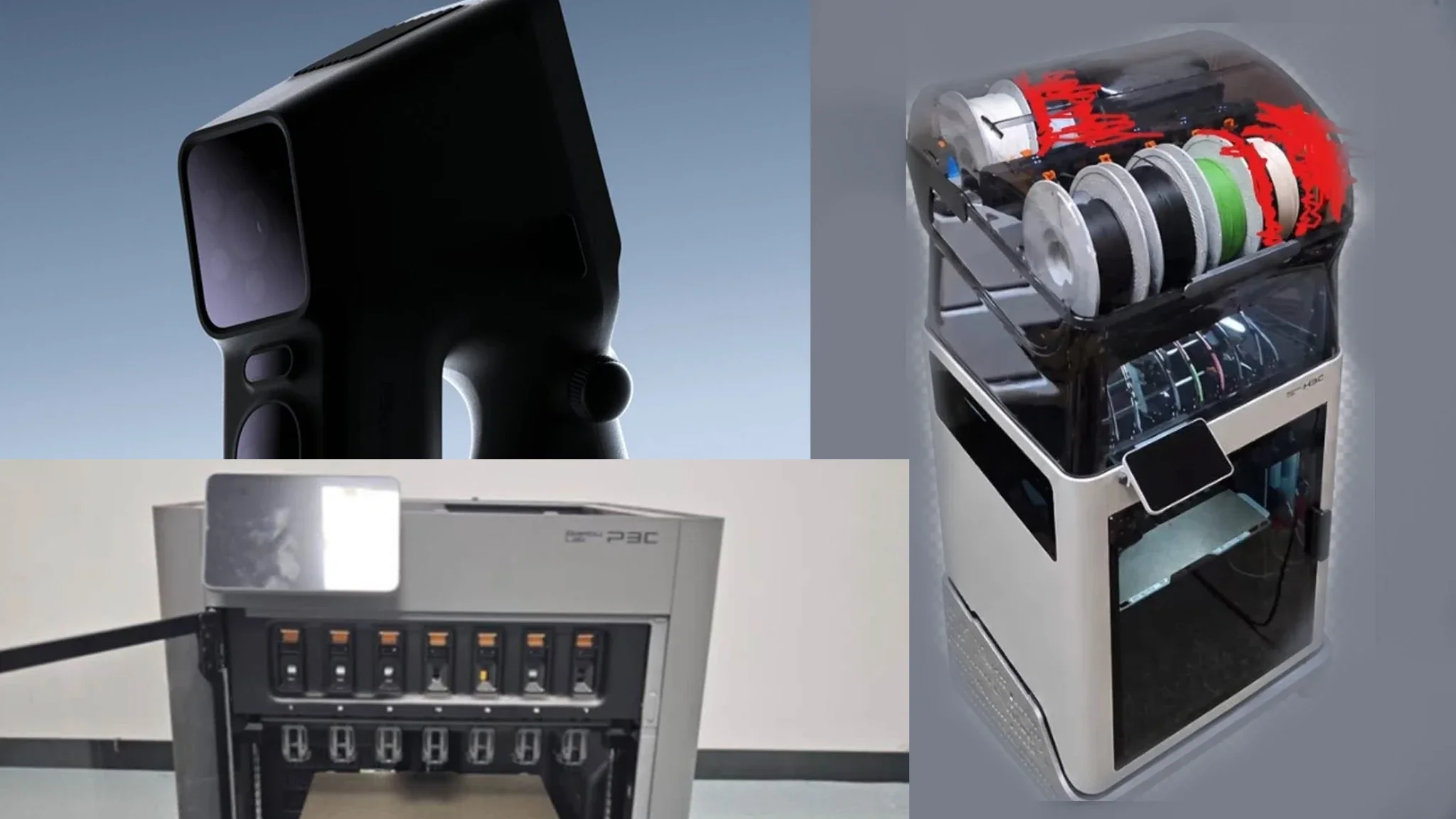
The teased S1 3D Scanner from Bambu Lab website, and a potential leaked H3C and P3C images.
New FCC filings and patents from Bambu Lab gives us enough to speculate what new products are coming between Q4 of 2026 and Q1 2027. Here are all the rumors and now released products and what I think is coming.
Bambu Lab have just released their new R1 Laser Cutter and engraver, their first real step outside of 3D printing. And with the new rumored products, they are again pushing the envelope with the Bambu Lab S1 - A 3D scanner!
Update October 12, 2026: The S1 3D scanner is officially teased here, for a November launch!
Update November 3, 2026: The H3C is out! At a suprisingly low $2,499 / €2,499 for the Combo with nine tools and the AMS 3H. No P3C and no S1 at the launch. Quick verdict in the H3C section below, while my initial thoughts and a full comparison against the U1, Creator 5 Pro, K3, XL and Core One INDX coming in the next days.
Those arn’t the only products we expect to see in the next few months: P3C, X2D Pro and new AMS units. Let’s explore what these product most likely are.
Bambu Lab H3C - Launched November 3, 2026 and its better than we thought!
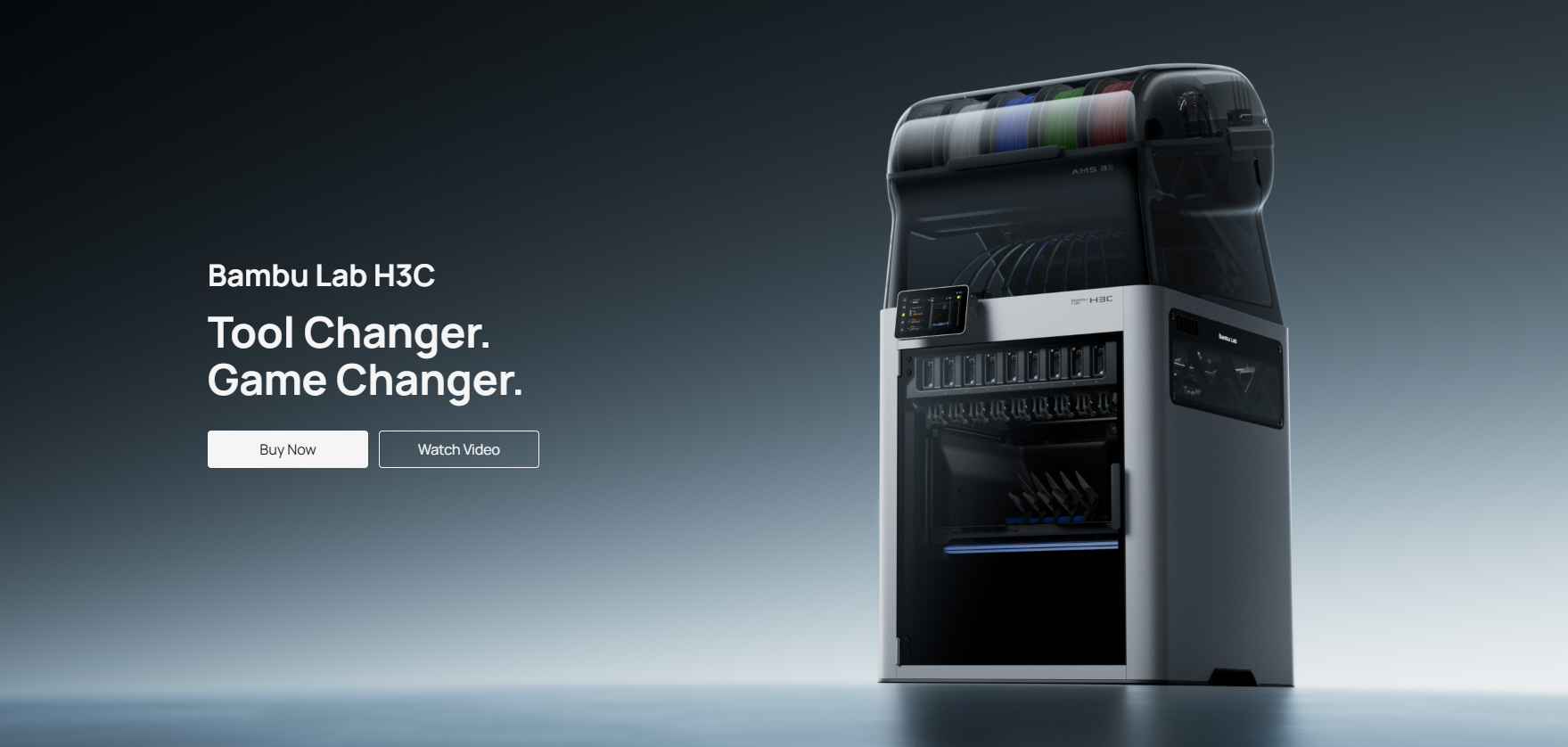
H3C quick specs:
Price: $2,499 / €2,499 / £2,199 for the H3C AMS Combo (printer + AMS 3H)
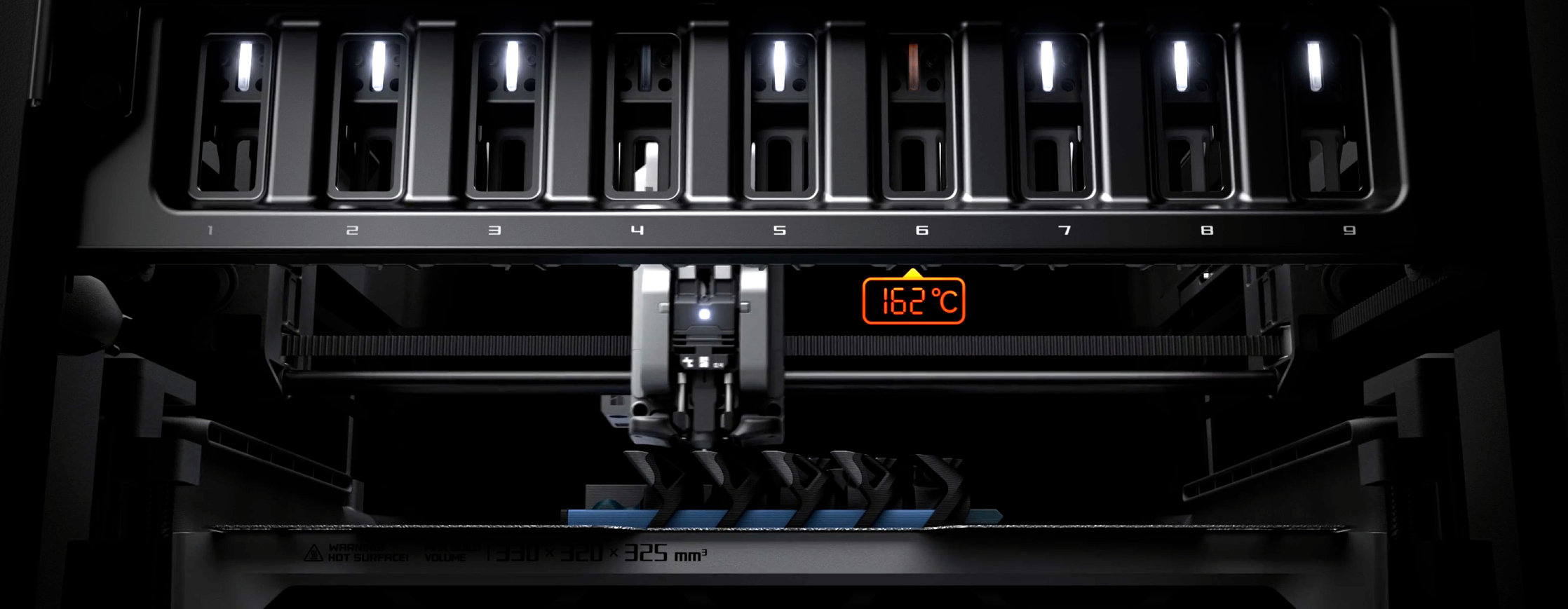
9 tools (Swaptek), tool change under 6 seconds, mixed nozzle sizes in one print.
330 × 320 × 325 mm, 65 °C chamber, 350 °C hardened nozzles for abrasives.
AMS 3H: 9 spools in one compartment, RFID, drying to 85 °C while printing, up to 24 materials with extra AMS.
2.85 mm FlexFeed path and TPU as soft as 75A.
Wi-Fi 6 (no Ethernet.)
Bambu Lab H3C features and technology
The new H3C moves away from the Vortek system in H2C and into individual tools. A whopping 9 of them.
The toolchaning is a “cleaner” approach to multi-material (and color) printing that have several benefits over both AMS-swapping and Vortek toolhead swapping.
With individual toolheads, each filament is “always loaded” and thanks to the individual heaters on each tool, they can cool, hold and pre-heat temperature when needed. This makes swapping materials technically as fast as 6 seconds (but we expect real time to be slower when you account for the 0.038g purge needed). This purge can probably be done either inside the model or at a prime tower.
From my testing with Flashforge Creator 5 Pro, I know for a fact this will speed up 3D printing in multicolor (and multi-material) with faster swaps and less purging. Something my Flashforge Creator 5 Pro article and video really highlights compared to a AMS system.
Everything else I wrote before the H3C launch, kept for the record and to be updated shortly:
P3C - Budget tool changer from Bambu Lab
The new P3C rumors are interesting! This for me indicates a P-sized printer (256×256×256mm) build volume. A more budget friendly machine with the same 3rd generation upgrades to the H3C platform. The C in P3C indicates tool-changing as well, although I expect 4-5 tools instead, potentially 4 from a new gen AMS and 1 externally fed from the spoolholder.
Update: The images above shows a whopping 7 tools! on a single extruder solution. If this is priced right, it will be the most interesting machine of 2026 (and a good part of 2027). Make sure you sign up here to get notified when it goes live.
The P3C is going to be really interesting as Bambu Lab have had “tough” competition from brands like Snapmaker U1 or Flashforge Creator 5 that both have 4 independent toolheads closer in price to the P-series than H2C. In my own video with a typical 4-color multicolor print, the Creator 5 Pro spent almost 900 grams less waste in one print, and around 1/3 of the print time.
So a P3C and the H3C for that matter, are welcome additions for anyone doing a lot of multi color printing and need to cut down on printing time and waste costs.
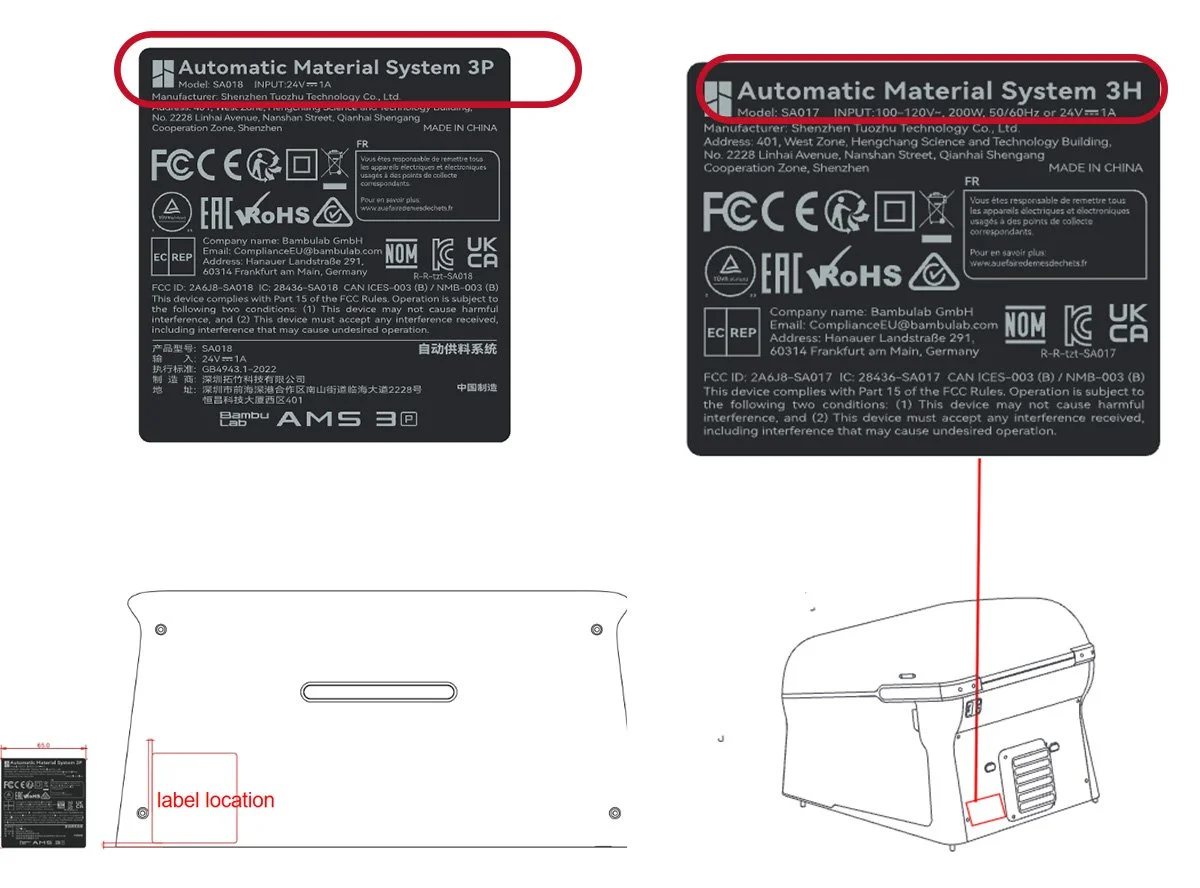
Bambu Lab 3H and 3P AMS systems shown. Notice width of modules.
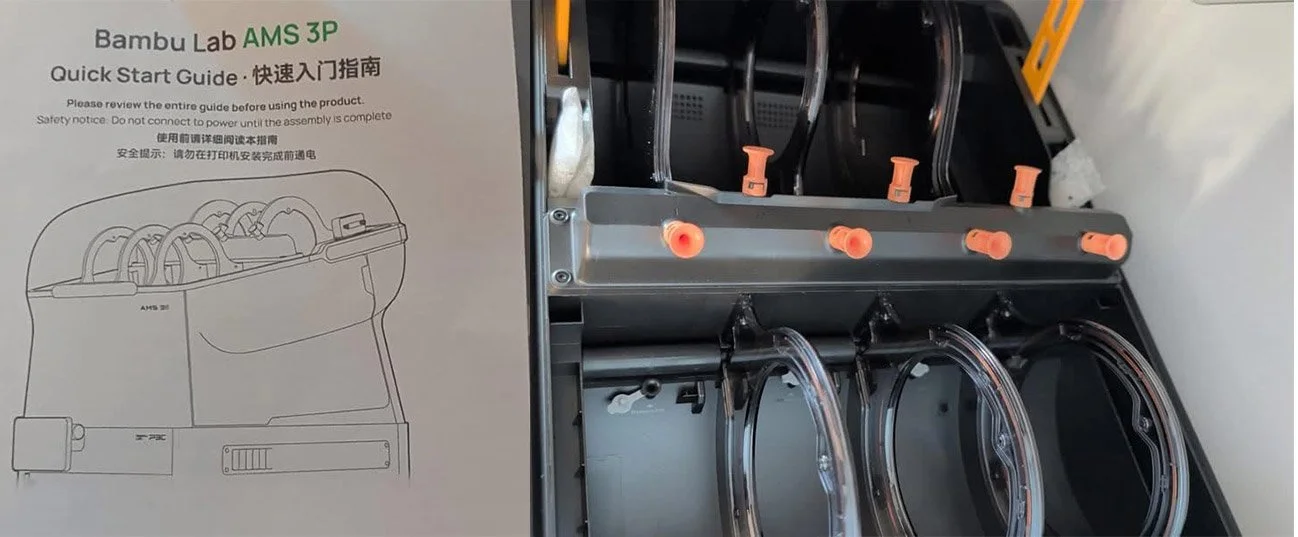
The updated leaked AMS 3P.
Third Generation AMS - Automatic Material Station
The new AMS 3P and 3H are the two new AMS fit for 3rg gen 3D Printers from Bambu Lab. We now have an image of the AMS 3P, which has 7 slots. Combined with the leaked P3C images, showing 7 toolheads, I suspect the 3P stands for P-series (7 slots). This means the new AMS 3H would be for H-size and houses 9 spools
The AMS 3H appears to have 100-120V 200W rating which probably enables stand-alone drying as well.
Both are most likely designed to optimize toolchanger feeding, so one filament to each tool. I still suspect there are some solution to run multiple AMS 3 or earlier to enable more than 7 or 9 colors on these new machines.
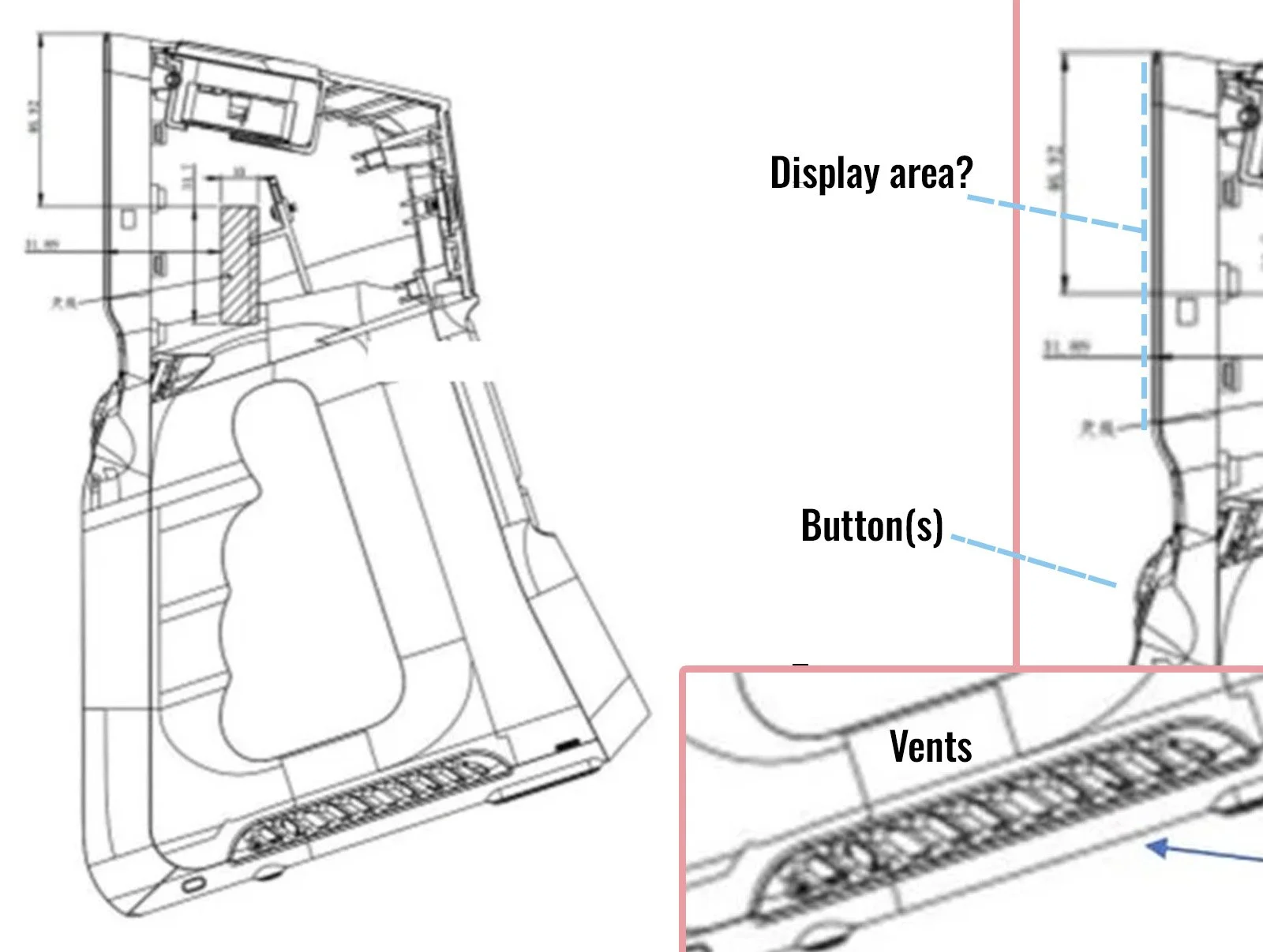
The FCC 2A6J8-DS001 filing revealing Bambu Lab S1 3D scanner. With some exciting features!
Bambu Labs first 3D scanner
Looking at the new FCC filings (2A6J8-DS001) we see the S1 3D scanner mentioned. It includes an illustration of where the label would go, and that illustration tells us a few things, like there’s a proper grip, medium-sized scanning FoV based on the angles of the design, button and screen on left side.
There is air-vents, indicating there is a fan needed, so white or blue structured light with color-scanning (texture-flash) most likely.
Today, most scanners have multiple technologies incorporated like multi-line blue lasers (cross, parallel and single) as well as Near-Infrared light (NIR) or structured light. Sometimes in different Field of Views (for example NiR for scanning people, and laser for mechanical parts 10-100cm in size).
The label also mentions 60w, and i’m conflicted if this means the scanner is stand-alone or not.
On one side, 60w is great charging power via USB-C, but then the label would probably include something about battery or mAh. I don’t see those indicators, so potentially this is a USB-C powered plug-in scanner to your PC.
On the other hand, a SGS North America seems to indicate that the S1 transmits via WiFi in 5hz band, so most likely wireless transfer to a PC (or via cable?).
Some have speculated that since SCANTECH and Bambu lab partnership in January 2026, the new S1 would build on their technology. For example the 3DeVOK formfactor. These scanners are not stand-alone, but the display and button(s) would fit right at the patent illustrations upper left corner. With that said, 3DeVOK MT Gen2 is rated 12 V/5 A = 60 W and uses blue laser plus IR structured light; the S1 label shows 20 V/3 A = 60 W… coincidence?

The officially teased Bambu Lab S1 3D scanner image. I see both blue laser, Texture flash and IR-cameras. So this is promising! There also seems to be a knob for rotating. Maybe brightness or preview-zoom?
Making 3D scanning work for hobbyists is difficult
For this to make sense, Bambu Lab would have had to overhauled both user interface, software and simplicity to make it reachable for their users. The 3D-Scantech is tech only and no bling…
Even then, 3D scanning is very difficult for the average user. Scanning creates mesh, and for anything technical, it’s basically a reference that you later design new parts from. Taking this to the hobbyist level of Bambu Lab products isn’t realistic.
Therefor, I expect the Bambu Lab S1 3D scanner to target the more professional-side of their users, and offer performance close to the $900-2000 range products like Revopoint MetroX or Creality Raptor Pro.
One feature I’d really like to see in the Bambu Scanning application is to take the color data from a scan (let’s say you scan a cool Chinese vase) and apply a conversion of that color data into number of filaments. So if you want 3 colors, it will match the scan to 3 colors in slicer, making it easier to multi-color print from scans.
The Bambu Lab X2D Pro probably isn’t very Pro
Although it’s not called X2E, I assume this is mostly a enterprise solution of the X2D, with special networking for enterprise solutions. Potentially some increased temperatures for nozzles and build plate to motivate the “Pro” part.
X2D Pro is probably also paired with the AMS 3H for dual-material handling.
Suspected release dates
The FCC filing timing and non-public details (STC-terms) seem to indicate a maximum 6 month confidentiality, meaning we should see these products launched end of March 2027 at latest. Technically the STC date is when documents become public, not a launch deadline per say. Bambu Lab can launch earlier and the documents stay hidden until the 6 month date.
Now we have confirmed November 3 release date for the H3C, so I suspect the S1 is there as well. The P3C has not had any leaks or teasers like the others, so it might be a later launch, or a apple “one more thing” announcement.
I think it’s great that Bambu Lab teases these products ahead of their 2026 Black Friday sale, so we know what to expect, and what to consider buying or not. Making consumers a bit more informed.
I actually built just launched a website for you to track deals on 3D printers, and get notified when the product you want is on sale, and not get spammed by other newsletters. It’s called 3dp.sale and below you can track the Bambu Lab printers you’re interested in. All free, no account and no annoying BS. Just a notification when there’s a sale or unique discount code for you.
Prices of 3rd generation Bambu Lab 3D Printers and S1 3D scanner
I think we’re going to see quite similar prices to existing models, with a small bump to “cover costs” for the The fresh $27.6M Stratasys verdict.
My guesses are:
Bambu Lab H3C Combo t $2299 (ended up $2499 for the Combo, which is still cheap!)
Bambu Lab P3C Combo at $899 - still competing with Snapmaker U1 and Creator 5 Pro
Bambu Lab X2D Pro coming in at $1099
Bambu Lab S1 3D scanner debuting at $999 competing with Revopoint MetroX
